> ## Documentation Index
> Fetch the complete documentation index at: https://docs.blockdb.io/llms.txt
> Use this file to discover all available pages before exploring further.
# Lineage
> How BlockDB ties derived rows back to on-chain events using stable identifiers and coordinates.
## Overview
Every record BlockDB delivers comes with a **mathematical receipt you can independently verify**.
You can always ask: **where did this come from, and was it computed correctly?**
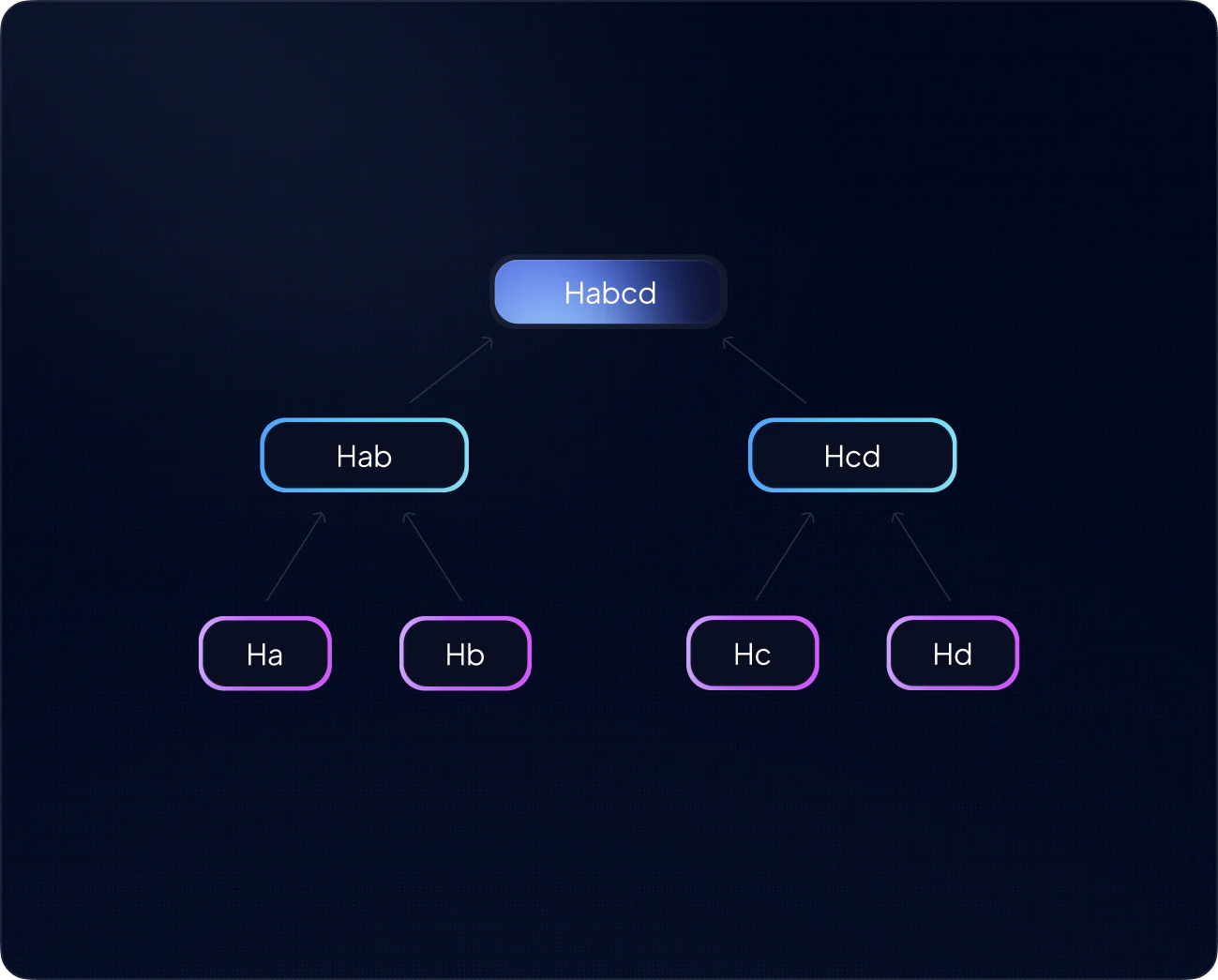
**Lineage is the answer** — a traceable path from any derived row (a price, a pool snapshot, a transfer) back to the raw on-chain log that produced it, anchored by cryptographically stable coordinates and verifiable against the Merkle trie that secures the chain itself.
 ***
## What Lineage Gives You
`_tracing_id` repeats across API responses and warehouse exports for the same logical row — safe to store, join, and use in support tickets.
`block_height`, `transaction_hash`, `log_index`, and related fields anchor every row to chain execution, where the DDL defines them.
Shared coordinates and [dataset IDs](/api-reference/enumerations/dataset-id) let you join OHLC, reserves, transfers, and primitives in SQL or notebooks.
***
## Tracing Fields
| Location | Field | What it provides |
| --------------- | --------------------------------------------------------------------- | --------------------------------------------------------------------------- |
| APIs (`/evm/*`) | `_tracing_id` | Opaque per-tenant handle for the row when present in that dataset's schema. |
| SQL exports | `_tracing_id`, `_created_at`, `_updated_at` | Mirror API fields for warehouses (where the table defines them). |
| Row payloads | `block_height`, `transaction_hash`, `log_index`, pool/token addresses | Direct anchors to chain state and protocol entities. |
Not every aggregate table includes `_tracing_id` or `tracking_ids_view[]`. Use the [data catalog](/data-catalog/evm/dataset-index) for the exact column list per table.
***
## Lineage API
For programmatic provenance expansion, use the Historic API [Lineage](/api-reference/evm/lineage/overview) suite:
`POST /evm/lineage/record` — retrieve lineage metadata for a specific row.
`POST /evm/lineage/parents` — walk the provenance graph up to parent records.
***
## What Lineage Gives You
`_tracing_id` repeats across API responses and warehouse exports for the same logical row — safe to store, join, and use in support tickets.
`block_height`, `transaction_hash`, `log_index`, and related fields anchor every row to chain execution, where the DDL defines them.
Shared coordinates and [dataset IDs](/api-reference/enumerations/dataset-id) let you join OHLC, reserves, transfers, and primitives in SQL or notebooks.
***
## Tracing Fields
| Location | Field | What it provides |
| --------------- | --------------------------------------------------------------------- | --------------------------------------------------------------------------- |
| APIs (`/evm/*`) | `_tracing_id` | Opaque per-tenant handle for the row when present in that dataset's schema. |
| SQL exports | `_tracing_id`, `_created_at`, `_updated_at` | Mirror API fields for warehouses (where the table defines them). |
| Row payloads | `block_height`, `transaction_hash`, `log_index`, pool/token addresses | Direct anchors to chain state and protocol entities. |
Not every aggregate table includes `_tracing_id` or `tracking_ids_view[]`. Use the [data catalog](/data-catalog/evm/dataset-index) for the exact column list per table.
***
## Lineage API
For programmatic provenance expansion, use the Historic API [Lineage](/api-reference/evm/lineage/overview) suite:
`POST /evm/lineage/record` — retrieve lineage metadata for a specific row.
`POST /evm/lineage/parents` — walk the provenance graph up to parent records.