

Overview
BlockDB indexes every emitted EVM log and all internal transactions individually — one row per event, no aggregation at index time. This is the architectural foundation that makes tick-by-tick price data and full tick range reconstruction possible for dynamically distributed liquidity protocols like Uniswap v3 and v4.What This Enables
Tick-by-Tick Prices
Because everySwap log is captured individually, BlockDB produces a price print per swap — not per block, not per minute:
- Each swap event yields one realized price observation
- Continuous price history is reconstructable at any resolution, without interpolation
- Swap prints carry execution metadata: pool, tokens, amounts in/out, fee tier
b0302_token_to_token_prices_swap_prints_v1 — the highest-resolution price dataset BlockDB publishes.
Full Tick Range for Concentrated Liquidity Protocols
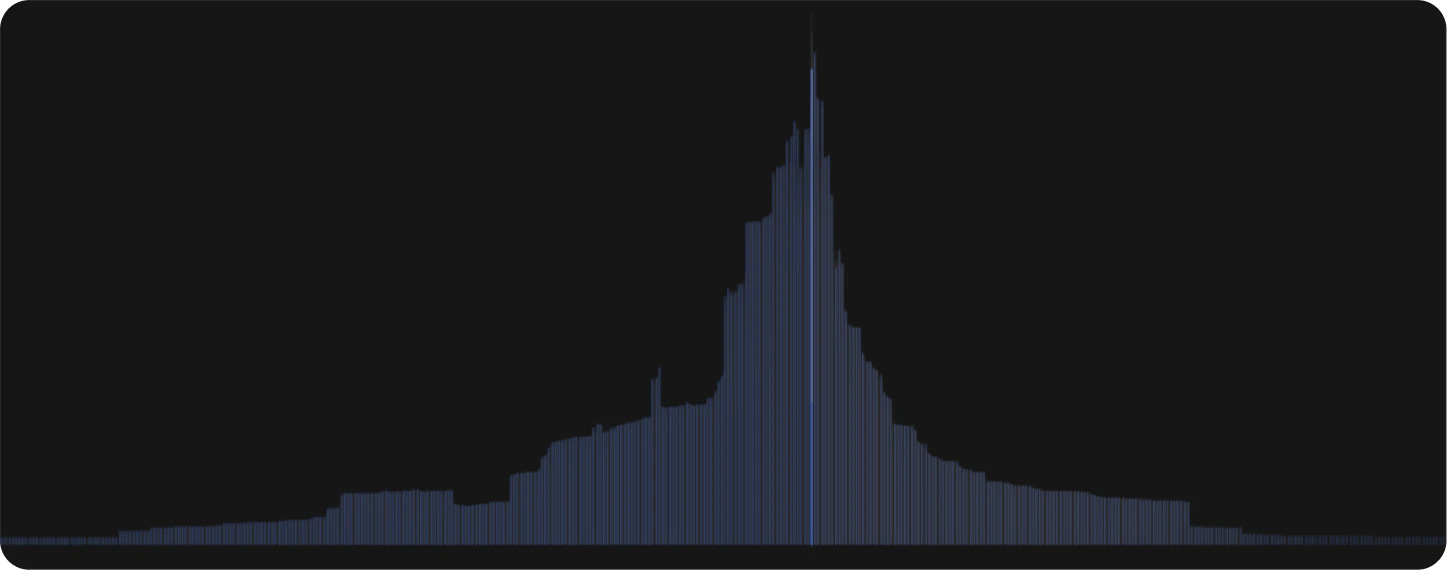
Protocols like Uniswap v3 and v4 distribute liquidity across discrete price ticks rather than uniformly across the curve. Reconstructing the full tick range — and how it shifts over time — requires capturing everyMint, Burn, and Swap event.
BlockDB indexes all of these as individual rows, which makes it possible to:
- Reconstruct the complete active tick range at any block / tx / log index
- See exactly where liquidity is concentrated at any point in time
- Track how individual positions open, adjust, and close
- Compute in-range vs. out-of-range liquidity for any price interval
b0301_liquidity_pools_reserves_v1 and its companion detail table.
See the dataset index for each table’s grain and key columns.